What the guide is
The Eatwell Guide was published by Public Health England, with the devolved administrations of Scotland, Wales and Northern Ireland, and replaced the earlier Eatwell Plate. It is used by the NHS and is the basis for most dietary advice given in schools, hospitals and public campaigns in the UK. It shows a plate divided into segments sized by the proportion each food group should take across the day or week. It applies to most people over the age of two. It does not apply to people with specific medical dietary needs, who are directed to a health professional.
Where potatoes sit
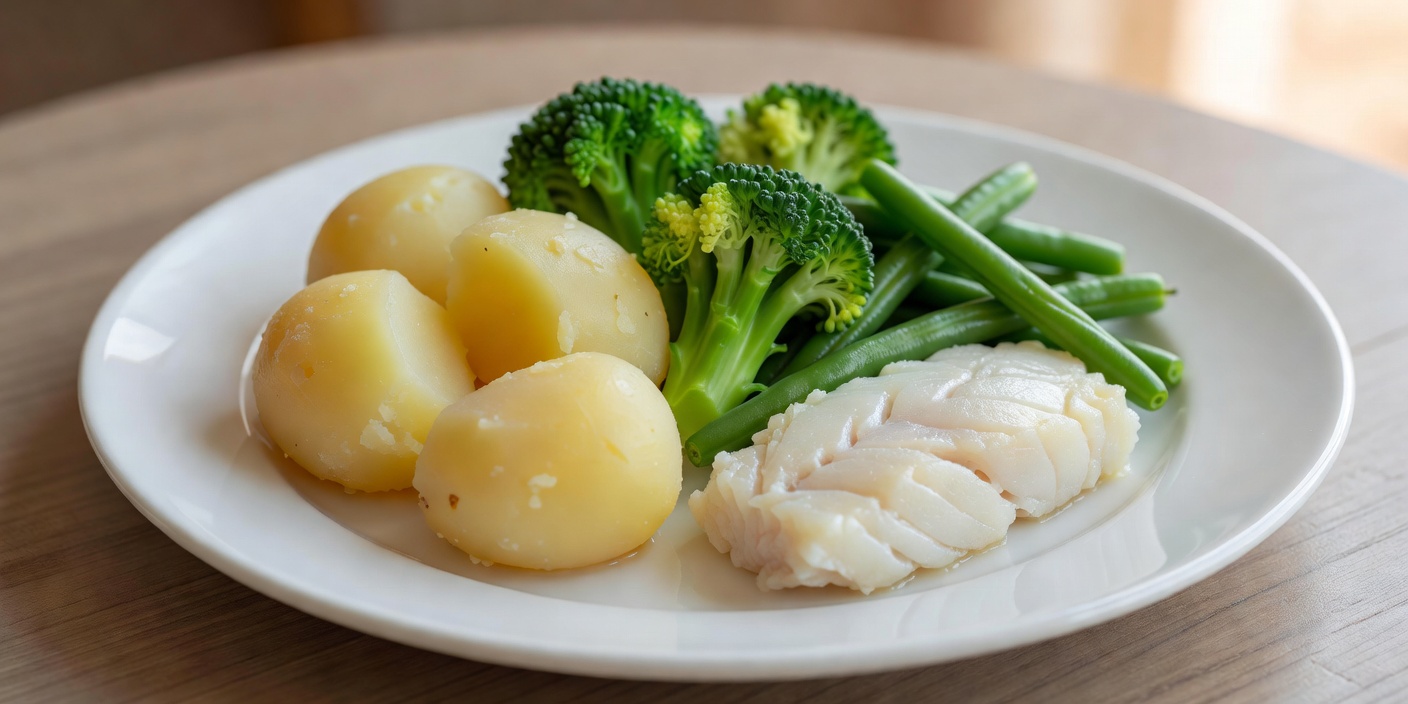
Potatoes are named first in the starchy carbohydrate segment, alongside bread, rice, pasta, and other starchy foods such as couscous, oats and cereals. The guide's stated reason is their role: they are the main source of energy and a large share of the fibre in the UK diet, eaten as a base to a meal rather than as an accompaniment. The guide advises choosing "wholegrain or higher fibre versions with less added fat, salt and sugar". For potatoes, the higher fibre version is the one with the skin left on, and the lower fat version is the one that has been boiled, steamed, baked or mashed without large amounts of butter rather than roasted or fried.
Why potatoes do not count towards 5 A Day
The NHS 5 A Day pages are explicit. Potatoes, yams, cassava and plantain do not count, because they are classified nutritionally as starchy foods. Sweet potatoes, parsnips, swedes and turnips do count, because they are usually eaten in addition to the starchy portion of a meal rather than instead of it. The distinction is about the role a food plays on the plate, not a judgement that potatoes lack nutritional value. The nutrients report sets out what they contain.
The practical consequence is straightforward. A meal of a jacket potato with baked beans and a side salad counts the beans (as one portion, whatever the quantity) and the salad towards 5 A Day, but not the potato. Swapping the potato for a sweet potato would add a portion. Neither meal is more or less in keeping with the Eatwell Guide as a whole.
What "just over a third" means in practice
The guide does not give gram weights for each segment. It describes proportion. Starchy carbohydrates and fruit and vegetables together occupy the larger part of the model; dairy and alternatives, protein foods and unsaturated oils occupy smaller segments; foods high in fat, salt and sugar sit outside the plate and are marked as to be eaten less often and in small amounts. Crisps appear in that outer group, not in the starchy segment. Chips are a starchy food that has taken on fat in cooking, and the guide's advice to choose lower-fat versions applies.
The British Nutrition Foundation publishes practical portion guidance that uses hand measures rather than scales. For potatoes its approach is a portion of roughly fist size, adjusted for the person and the rest of the meal. Those figures are guidance, not rules, and the Foundation's own materials should be read for the detail.
The Eatwell Guide describes a pattern across days and weeks. A single meal does not need to match the plate exactly. Someone eating rice at one meal and potatoes at the next is following the guide as intended.
How other national guides differ
National guidance is not uniform on potatoes, and the differences are worth knowing when reading advice from outside the UK.
- Ireland. The Department of Health's Food Pyramid puts potatoes on the same shelf as wholemeal cereals, breads, pasta and rice, matching the UK approach.
- United States. The USDA's MyPlate counts potatoes as vegetables, specifically as starchy vegetables, and includes them in the vegetable recommendation.
- Canada. Canada's Food Guide groups foods into vegetables and fruits, whole grain foods and protein foods; potatoes fall within vegetables and fruits.
- Nordic countries. The Nordic Nutrition Recommendations, used by Denmark, Finland, Iceland, Norway and Sweden, treat potatoes as a separate staple and discuss them alongside cereals rather than counting them as vegetables.
None of these systems disputes the composition of a potato. They differ in how they choose to group it for public messaging. A UK reader following advice written for a US audience should be aware that "eat more vegetables" there includes potatoes, while here it does not.
What the guide does not say
The Eatwell Guide sets no upper limit for potatoes and does not single them out for restriction. It does not rank starchy foods against one another. It does not say that potatoes are fattening; it says that the way starchy foods are cooked and what is added to them affects their fat and salt content, and that lower-fat, higher-fibre versions are the better choice. Where a source claims the NHS advises avoiding potatoes, the guide itself does not support that reading.